Stamped Concrete in Lake City, FL
Lake City Concrete Services designs and installs stamped concrete for homeowners across Lake City and Columbia County. The look of natural stone or brick at a fraction of the cost, built to last in Florida's climate.
25+
Years Serving Lake City
550+
Projects Completed
4.9
Average Star Rating
The Look You Want Without the Maintenance You Don't
Stamped concrete gives you the appearance of natural stone, brick, slate, or tile without the ongoing maintenance, shifting, and weed growth that comes with those materials. It is poured as a single continuous slab, which means no pavers to settle unevenly over time, no gaps for grass and weeds to push through, and no individual pieces to crack, shift, or need replacing after a few seasons.
In Lake City, where outdoor living is a genuine part of daily life for a good portion of the year, the surface you choose for your patio, pool deck, or front entry makes a real difference in how your property looks and functions. Stamped concrete bridges the gap between the durability and low maintenance of standard concrete and the visual appeal of more expensive natural materials. Homeowners who want their outdoor space to look distinctly better than a plain gray slab without committing to the cost and upkeep of natural stone consistently find stamped concrete to be the most practical and attractive middle ground.
Where Stamped Concrete Makes the Most Sense
Stamped concrete works particularly well in areas where appearance matters as much as function. Backyard patios are the most common application we see, where homeowners want an outdoor living space that looks intentional and finished rather than purely utilitarian. Pool decks are another strong use case, as stamped concrete can be finished with textures that provide grip underfoot while still looking far more attractive than plain brushed concrete.
Front entry walkways and driveways are also popular applications for stamped concrete in Lake City. A stamped front entry immediately improves the curb appeal of a property in a way that a standard gray sidewalk simply cannot. Driveways done in stamped concrete with a cobblestone or large-format stone pattern stand out significantly and add real visual value to the front of a home.
What stamped concrete is not well suited for is areas where the slab is already structurally compromised or where the base has significant settlement issues. Stamped concrete requires a solid, stable base to perform correctly, and the pattern and color will highlight any unevenness in ways that plain concrete would not. We assess the base conditions carefully before recommending stamped concrete for any application.
How Stamped Concrete Is Installed
The installation process for stamped concrete follows the same foundational steps as any concrete pour, with additional stages for color application and pattern stamping that require careful timing and skill to execute correctly. Base preparation comes first. The area is excavated, the soil is compacted, and forms are set to define the edges and slope of the slab. Getting drainage right at this stage is especially important for stamped concrete because the finished surface will be sealed, and water that has nowhere to go will sit on top rather than absorbing into the material.
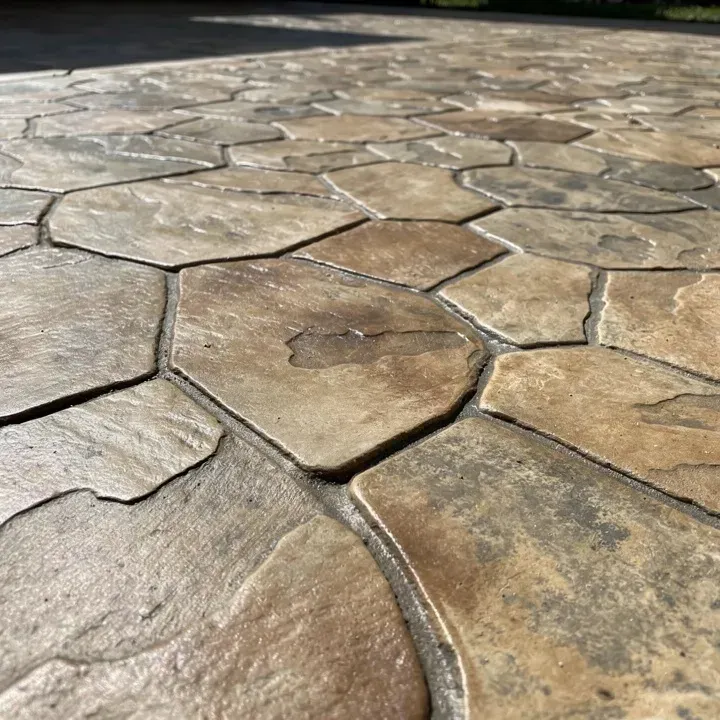
Once the base is ready and the forms are set, the concrete is poured and brought to an initial level finish. Integral color is mixed directly into the concrete before the pour, which distributes color uniformly through the entire thickness of the slab rather than just on the surface. A release agent in a complementary or contrasting color is then applied to the surface before stamping, which settles into the recesses of the pattern and creates the natural variation and depth that makes stamped concrete look like individual stones rather than a single flat surface.
The stamping itself happens during a specific window after the pour when the concrete is firm enough to hold a pattern but still workable. This is the most time-sensitive part of the job and the stage that requires the most experience to get right. Stamps are pressed into the surface in a consistent overlapping pattern, carefully aligned to avoid visible seams or mismatches. Once the stamping is complete and the concrete has cured fully, a penetrating sealer is applied to protect the color, enhance the appearance, and make the surface easier to clean and maintain over time.
What Determines the Cost of Stamped Concrete
Stamped concrete costs more than standard concrete, and understanding why helps homeowners make an informed decision about whether it is the right choice for their project. The additional cost comes from several sources. The color materials, both the integral color mixed into the concrete and the release agent applied before stamping, add to the material cost of every job. The stamping process itself requires more labor and more skill than a standard broom finish, and the timing demands of the stamping window mean the crew needs to work efficiently and precisely.
Pattern complexity affects pricing as well. A straightforward large-format stone pattern is less labor-intensive than a detailed cobblestone or herringbone brick pattern that requires more stamps, more alignment work, and more time to execute cleanly. The size of the area being stamped is the primary pricing factor as always, with larger surfaces requiring proportionally more material and labor.
Sealing adds a modest cost but is not optional for stamped concrete. An unsealed stamped surface will fade, stain more easily, and deteriorate faster than one that is properly sealed. We include sealing as a standard part of every stamped concrete job because it is essential to the longevity and appearance of the finished surface. Resealing every few years is the primary ongoing maintenance requirement for stamped concrete, and we are happy to discuss a maintenance schedule with you when the job is complete.
Frequently Asked Questions
How does stamped concrete hold up in Florida's heat and rain?
Stamped concrete performs well in Florida's climate when it is installed correctly and maintained with periodic resealing. The heat causes concrete to expand and contract, which is why proper expansion joint placement during the pour is important. Heavy rain is not a problem for a slab that was poured with the correct drainage slope. The sealer protects the color and surface from UV fading and moisture penetration, and reapplying it every two to three years keeps the surface looking good and performing well for decades.
How long does stamped concrete last compared to pavers?
A properly installed and maintained stamped concrete slab will typically outlast a paver installation in Florida's climate. Pavers are individual pieces that shift, settle unevenly, and develop gaps over time as the base material moves beneath them. Stamped concrete is a single continuous slab that moves as a unit, and while it can crack, a well-prepared base and correctly placed expansion joints minimize that risk significantly. The maintenance requirement for stamped concrete is also lower than for pavers, which need periodic releveling, weed control, and joint sand replacement.
Can stamped concrete get slippery when wet?
It can, depending on the pattern and finish. Very smooth stamp patterns with minimal texture can become slippery in wet conditions. We account for this during the design phase by recommending patterns with enough surface texture to provide grip underfoot, particularly for pool decks and areas that will regularly get wet. A light broom finish applied between stamping and sealing can also add grip without significantly affecting the appearance of the pattern.
Can existing plain concrete be stamped or resurfaced to look like stamped concrete?
Existing concrete cannot be stamped after it has cured, since stamping requires the concrete to be in a specific workable state immediately after the pour. However, a stamped concrete overlay can be applied to an existing slab in certain situations where the slab is structurally sound and in good condition. Overlays are thinner than a full pour and have limitations in terms of durability and longevity compared to a proper stamped concrete installation. We assess existing slabs on a case by case basis and give you an honest recommendation on whether an overlay is appropriate or whether a full replacement would serve you better.
Ready to Get Your Concrete Done Right?
Whether you are dealing with a cracked driveway that has been bothering you for too long, planning a new patio, or starting a build that needs a solid foundation, Lake City Concrete Services is ready to help. We offer free on-site estimates with no pressure and no obligation. You tell us what you need, we come out and take a look, and we give you a straight number based on what we actually see. No guesswork, no vague ranges, no surprises when the bill comes.
Give us a call or send us a message and we will get back to you promptly. Most estimates can be scheduled within a few days. The sooner you reach out, the sooner we can get your project on the calendar.

Contact
(386) 961-4864
Mon–Sat: 7am–7pm
Lake City, FL
About Us
Lake City Concrete Services is a locally owned contractor serving homeowners in Lake City and throughout Columbia County for over 25 years. We show up when we say we will, do the work correctly, and treat every property like it matters. We serve communities across Columbia County including Fort White, Lake Butler, Jasper, and Live Oak, and are happy to discuss projects in surrounding counties as well.
© Copyright 2026 Lake City Concrete Services. All rights reserved.
© Copyright 2026 Lake City Concrete Services.
All rights reserved.